
On July 23, 2026, the news of Japanese novelist Keigo Higashino’s passing from colorectal cancer saddened countless readers. He illuminated countless nights with his words, yet could not hold back the disease.
Beyond grief, we must confront a reality: colorectal cancer is a disease that typically takes years to progress from early signs to a full-grown tumour — it leaves us a window, but too many people either don’t know about it, or choose to ignore it.
What Kind of Disease Is Colorectal Cancer?
Colorectal cancer, as the name suggests, is a malignant tumour that develops in the colon and rectum. Together, the colon and rectum are known as the “large intestine” — the final segment of the digestive system, responsible for absorbing water and electrolytes, storing and expelling faeces.
The global scale is staggering. In 2020, approximately 2 million new cases of colorectal cancer were diagnosed worldwide with roughly 1 million deaths, making it the third most common and second most deadly cancer globally. Men have a significantly higher incidence — about 44% more than women.¹
Even more alarming: while colorectal cancer rates are declining among older adults in high-income countries (thanks to widespread screening), rates among younger adults (under 50) are rising globally. By 2040, an estimated 3.2 million new cases and 1.6 million deaths are projected — increases of 63% and 73% respectively compared to 2020.¹
What Are Colorectal Polyps? Why Should You Care?
Colorectal polyps are small “bumps” or “mushroom-shaped” growths on the inner lining of the large intestine. They can be flat or pedunculated (on a stalk).
Their significance lies in the fact that most colorectal cancers do not appear overnight. Instead, they develop step by step from polyps. This process is called the “adenoma-carcinoma sequence” (adenoma-carcinoma sequence).²
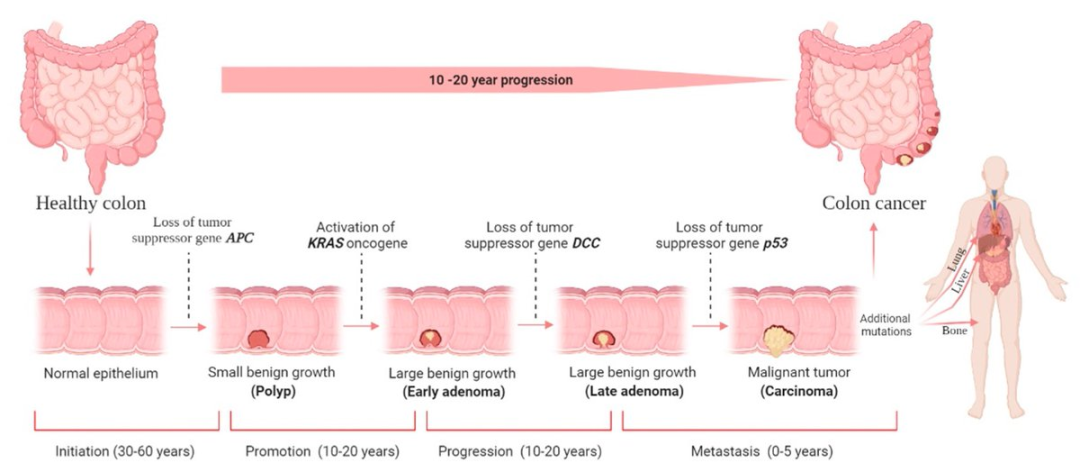
In simple terms, normal intestinal lining → polyp formation → dysplasia → cancer. This progression typically takes years to over a decade.
Do All Polyps Become Cancer?
No. There are many types of polyps, and their cancer risks differ vastly:
1. Tubular adenoma
The most common type. Those smaller than 1 cm without high-grade dysplasia have low cancer risk and are considered “low-risk” polyps — after removal, follow-up can follow the average-risk schedule.
2. Villous adenoma / Tubulovillous adenoma
Higher cancer risk.
3. Adenoma with high-grade dysplasia
Classified as an “advanced polyp”; relative risk (RR) approximately 3.5 to 6.5 times.
4. Serrated lesions
Including sessile serrated lesions (SSL) and traditional serrated adenomas. Those ≥1 cm or with cytological dysplasia are classified as “advanced” — their cancer risk should not be underestimated.³
The current consensus is that progression from adenomatous polyps to invasive colorectal cancer typically requires 5 to 15 years. This is precisely why the screening window for colorectal cancer exists — we have ample time to find and remove polyps before they “grow and spread.”
Having a first-degree relative (parent, sibling, or child) diagnosed with any type of colorectal polyp increases your own colorectal cancer risk.
A nationwide study covering over 11.6 million Swedish adults found: among those with one first-degree relative diagnosed with any polyp, the standardised incidence ratio (SIR) for colorectal cancer was 1.4; if that relative had two or more polyp diagnoses, the SIR rose to 1.8; and the SIR for early-onset (under 50) colorectal cancer was as high as 2.3.
Therefore, family history is a warning signal — it means you should screen earlier and more proactively, rather than panic or avoid the issue.
What Causes Colorectal Polyps and Colorectal Cancer?
The development of colorectal cancer is the combined result of modifiable lifestyle factors and non-modifiable genetic background.²
Risk Factors That Increase Risk (Modifiable):
1. Red meat and processed meat
The World Health Organization’s International Agency for Research on Cancer (IARC) classifies processed meat (bacon, sausages, cured meats, etc.) as a Group 1 carcinogen (same category as asbestos and cigarettes). Research shows that an additional 50g of processed meat per day increases colorectal cancer risk by approximately 16%; an additional 100g of red meat per day increases risk by approximately 12%.
2. Smoking
Has a significant promoting effect on all types of colon polyps (including adenomas and serrated polyps); RR approximately 1.18.
3. Alcohol
Moderate drinkers (2–3 drinks per day): CRC risk RR = 1.21; heavy drinkers (≥4 drinks per day): RR as high as 1.52.
4. Obesity and sedentary lifestyle
Weight gain is significantly associated with increased colorectal cancer risk (HR 1.23); prolonged sitting, even after controlling for obesity and exercise levels, is associated with increased colorectal cancer risk — especially early-onset colorectal cancer.
5. Type 2 diabetes
Diabetic patients have approximately 38% higher colon cancer risk than non-diabetics (RR 1.38), possibly related to insulin promoting colonic mucosal cell proliferation.
Risk Factors That Increase Risk (Non-Modifiable):
1. Age
Colorectal cancer is rare before age 40, begins to rise significantly between ages 40 and 50, and continues to increase with each subsequent decade.
2. Family history and hereditary syndromes
Lynch syndrome and familial adenomatous polyposis (FAP) are the most common high-risk hereditary syndromes, accounting for approximately 5% of all colorectal cancers.
3. Inflammatory bowel disease (IBD)
Patients with ulcerative colitis involving the entire colon (pancolitis) have a CRC risk 5 to 15 times higher than the general population.
Who Should Be Screened for Colon Polyps?
The answer is: virtually everyone — the starting age and frequency differ.
Average-risk individuals: Both the U.S. Preventive Services Task Force (USPSTF) and the American Cancer Society have lowered the recommended starting age for colorectal cancer screening from 50 to 45 for average-risk populations.¹
Those with a family history need earlier, more frequent screening³:
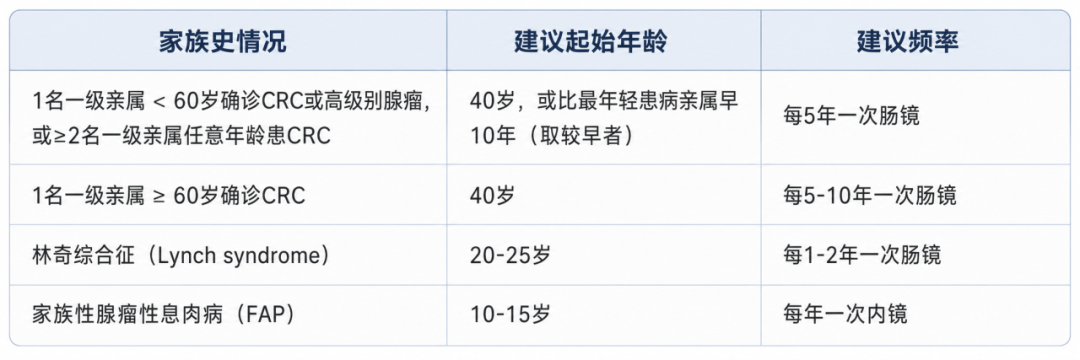
What Methods Are Available to Check for Polyps?
According to the **NCCN 2026 Colorectal Cancer Screening Guidelines (Version 2.2026)**⁶, the main screening methods currently fall into three categories.
Different methods have different strengths: endoscopic methods “see the most,” stool tests are “non-invasive and easy,” and blood tests “only require a blood draw.” The choice should be based on individual risk level, compliance, and available medical resources.
Endoscopic Methods (Can Directly Detect and Remove Polyps)
1. Colonoscopy
The “gold standard” for screening; once every 10 years.
Sensitivity for colon cancer: 94.7%; sensitivity for adenomas ≥10 mm: 89%–95%; sensitivity for adenomas ≥6 mm: 75%–93%; adenoma specificity: approximately 89%–94%. It can visualise the entire colon and remove polyps on the spot in one procedure — the preferred choice for high-risk individuals.
2. Flexible Sigmoidoscopy
Once every 5 years.
Can only visualise the distal colon (rectum and sigmoid colon). Sensitivity for overall colon cancer: 58%–75%; adenoma sensitivity: 72%–86%; specificity: approximately 92%. Suitable for those who refuse full colonoscopy, but cannot cover right-sided colon lesions.
3. CT Colonography (Virtual Colonoscopy)
Once every 5 years.
Sensitivity for colon cancer: 86%–100%; sensitivity for adenomas ≥10 mm: 89%; specificity: approximately 88%–94%. No sedation required, but still requires bowel preparation. If polyps are found, a separate colonoscopy is needed for removal.
Stool-Based Tests (Non-Invasive; Positive Results Require Colonoscopy Confirmation)
1. Faecal Immunochemical Test (FIT, quantitative)
Once every year.
Sensitivity for colon cancer: 74%–81%; sensitivity for advanced adenomas: 23%–28%; specificity: 93%–96%. The simplest to perform and an important alternative for those unwilling to undergo colonoscopy, but has a higher miss rate for precancerous lesions.
2. Second-generation multi-target stool DNA test (mt-sDNA)
Once every 3 years.
Sensitivity for colon cancer: 95%; sensitivity for advanced precancerous lesions: 43%; sensitivity for advanced neoplasia: 45%; specificity: approximately 89%–91%. Combines haemoglobin, DNA mutations, and methylation in a triple detection, with overall sensitivity superior to FIT alone. Any positive result requires further colonoscopy confirmation.
3. Stool RNA test (mt-sRNA)
Once every 3 years.
Sensitivity for colon cancer: 94%; sensitivity for advanced adenomas: 46%; specificity: 85% (adenomas). A newer technology; data is still accumulating.
Blood-Based Tests (Newest Non-Invasive Option)
Blood ctDNA test (bb-ctDNA): once every 3 years.
Sensitivity for colon cancer: 83%; sensitivity for advanced precancerous lesions: 13%; specificity: 90% (advanced neoplasia). Only requires a blood draw — the most convenient option. However, sensitivity for precancerous lesions is notably low. Currently serves as a supplementary option, suitable for those completely unable to complete stool or endoscopic examinations.
One-Sentence Summary
If you want the most comprehensive detection, colonoscopy (every 10 years) is the first choice; if you prefer non-invasive with relatively high sensitivity, mt-sDNA or mt-sRNA (every 3 years) are currently the best among stool/blood tests; if you simply want the easiest annual initial screening, quantitative FIT (every year) will do. After any positive non-invasive test, a colonoscopy must be arranged immediately for confirmation.
What Preparation Is Needed Before a Colonoscopy?
Colonoscopy requires thorough bowel cleansing so the physician can clearly visualise every part of the intestinal lining. General preparation steps include:
- 1–3 days before the procedure: Begin a low-residue diet (avoid foods with seeds or coarse fibre);
- The day before: Take the prescribed laxative (bowel cleansing agent) as directed; drink plenty of clear fluids (clear broth, plain water, colourless sports drinks);
- Day of the procedure: Nothing by mouth (specific cutoff time per physician instructions);
- Regular medications: Blood pressure medications can usually continue, but anticoagulants, antiplatelet agents, and diabetes medications require advance discussion with your doctor about whether to temporarily stop.
How Are Polyps Treated? Can They Recur?
Most polyps discovered during colonoscopy can be removed on the spot without separate surgery — this procedure is called a polypectomy. After removal, the specimen is sent for pathological examination to determine its type and grade, which forms the basis for the subsequent follow-up plan.
After polyp removal, regular follow-up is necessary, as there is a risk of recurrence or new polyp development. The follow-up interval depends on the polyp type:³
- Low-risk adenoma (1–2 small tubular adenomas, low-grade dysplasia): Follow the average-risk population schedule; intervals can be relatively long (generally 5–10 years);
- Advanced adenoma or high-grade polyp: First follow-up colonoscopy within 3 years; if results are negative, extend to 5-year intervals.
- Those with family history: Because colorectal cancer risk in those with family history returns to baseline more quickly after the colonoscopy’s protective period (one study showed the protective period is approximately 5 years), a 5-year interval for regular follow-up is recommended.
How to Prevent Colorectal Polyps and Colorectal Cancer?
Evidence-based medicine tells us the following changes are genuinely effective:
1. Regular exercise
A meta-analysis demonstrated that regular physical activity reduces proximal colon cancer risk by approximately 27% and distal colon cancer risk by approximately 26% — one of the most well-supported protective factors to date.²
2. Maintain a healthy weight
Obesity is an independent risk factor for colorectal cancer. Weight loss can even bring risk back close to average-population levels.
3. Reduce red meat and processed meat
The World Cancer Research Fund (WCRF) recommends limiting intake and strongly advises avoiding processed meat entirely.
4. Quit smoking and limit alcohol
Both are substantial modifiable risk factors.
5. Eat more vegetables, fruits, and whole grains
Plant-based dietary patterns (especially pesco-vegetarian, i.e. plant-based plus fish) are significantly associated with reduced colorectal cancer risk.
6. Aspirin (discuss with your doctor)
Long-term aspirin or NSAID use can reduce adenoma recurrence and CRC risk, but simultaneously increases gastrointestinal bleeding risk. Whether to take it requires individualised assessment.
Having read this far, I hope you now understand: colorectal cancer does not discriminate by identity, age, or profession. But unlike many other cancers, it offers a sufficiently long window from polyp to cancer for us to take action.
In the NORCCAP trial — one of the world’s largest randomised colonoscopy screening trials — researchers followed nearly 100,000 people for 23 years. Results showed that men who received a single sigmoidoscopy screening had a 28% reduction in colorectal cancer incidence and a 32% reduction in mortality over 23 years. One screening, over twenty years of protection.
This tells us: the colonoscopy you have today may be the most important decision you make twenty years from now.
If you have a family member who has had colon cancer or colon polyps, or if you are 45 or older, please schedule a colonoscopy. If you haven’t reached 45 but experience rectal bleeding, persistent changes in bowel habits, or unexplained iron-deficiency anaemia — please don’t attribute it to haemorrhoids or stress. See a doctor.
References
-
Eng C, Yoshino T, Ruíz-García E, et al. Colorectal cancer. Lancet. 2024;404(10449):294–310. https://doi.org/10.1016/S0140-6736(24)00360-X
-
Macrae FA. Epidemiology and risk factors for colorectal cancer. In: Shah SM, Seres D, eds. UpToDate. Updated June 11, 2026. Accessed July 27, 2026.
-
Grady WM, Issaka R. Screening for colorectal cancer in patients with a family history of colorectal cancer or advanced polyp. In: Elmore JG, Lamont JT, Swenson S, eds. UpToDate. Updated May 18, 2026. Accessed July 27, 2026.
-
Botteri E, Holme Ø, Løberg M, et al. Twenty-Three–Year Benefits of Sigmoidoscopy Screening for Colorectal Cancer: A Randomized Trial. Ann Intern Med. 2026;179:804–811. https://doi.org/10.7326/ANNALS-25-05456
-
Chambers AC, Merriel SWD, Beard G, et al. Early onset colorectal cancer. BMJ. 2025. https://doi.org/10.1136/bmj-2024-081436
-
National Comprehensive Cancer Network. NCCN Clinical Practice Guidelines in Oncology: Colorectal Cancer Screening. Version 2.2026. April 23, 2026.
Reviewed by: Dr. Li Tao — Distinct Healthcare Internal & General Medicine, Oncology Physician. Master’s degree from Peking Union Medical College; Visiting Scholar at MD Anderson Cancer Center, USA.
Content Editor: Luka
Disclaimer: This article provides general health information only. For individual medical concerns, please consult a qualified physician. For article reprint enquiries, please contact: medicine@distinctclinic.com.